Program report QB-6370 · filed September 28, 2026
CRM & Sales TechMeasured report
Cisco and Epic Join Forces to Merge CCaaS and CRM Workflows
Cisco has partnered with Epic to unify CCaaS and CRM software, targeting the agent context-switching tax. No benchmarks or timelines published yet — buyers should demand deployment data.
By Marcus Bennett3 min read649 words
Program notes
- Cisco announced a partnership with Epic to unify CCaaS and CRM software, per CX Today.
- The integration targets agent workflow friction from switching between contact center and CRM systems.
- No benchmarks, pricing, timeline, or named customers accompanied the announcement.
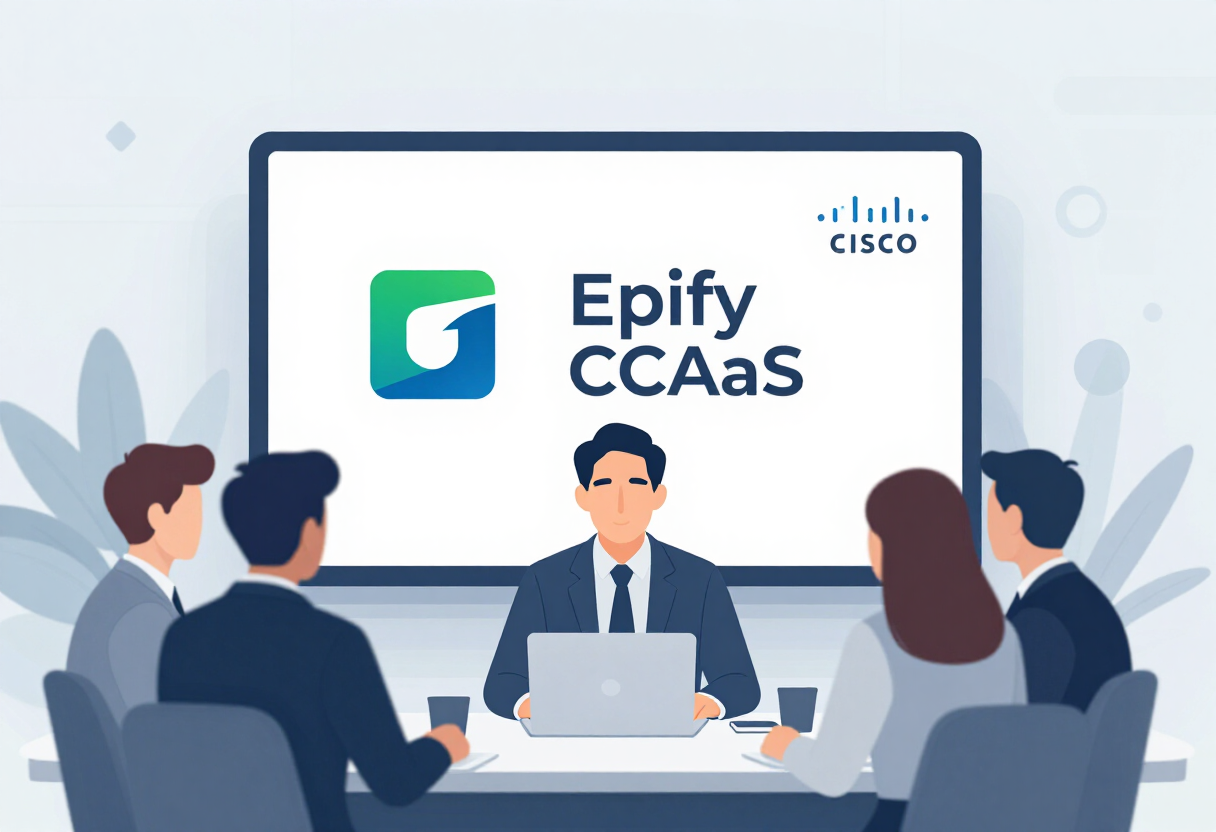
Cisco has announced a partnership with Epic to unify contact-center-as-a-service (CCaaS) technology with CRM software, according to a report from CX Today. The headline fact is structural rather than incremental: this is an integration play aimed at collapsing two software categories that contact center agents have historically toggled between on every single call.
For revenue and support teams, the deal targets a measurable workflow cost. Agents working across disconnected CCaaS and CRM stacks typically lose seconds per interaction to screen switching and manual data entry — time that compounds across thousands of daily contacts. Unified systems promise to surface customer records, case history, and call controls in a single interface, shortening handle times and reducing the error rate on after-call work.
What Cisco and Epic are proposing maps directly onto the stages where contact-center economics live or die: intake, authentication, issue resolution, and disposition logging. If the integration works as described, the authentication and intake steps compress the most, because identity verification and account lookup happen in one place rather than across two applications. That matters most for high-volume inbound teams — think hundreds of agents handling thousands of daily calls — where a five-second saving per interaction translates into meaningful capacity gains.
It matters less, at least immediately, for small support pods of five to ten agents, where the switching tax is real but small in absolute terms, and where the integration cost of a new vendor pairing may outweigh the productivity gain.
What is measured versus what is asserted
At this stage, everything about the partnership's impact sits firmly in the asserted column. The announcement establishes that the two vendors are working together to unify their product lines. It does not, based on the available report, publish benchmark data: no handle-time reductions, no customer-satisfaction deltas, no deployment counts, no named early customers, and no timeline for general availability.
Buyers evaluating the pairing should treat it the way a diligent revenue team treats any vendor claim — as a hypothesis requiring evidence. The questions that separate a real integration from a press release are concrete. Does the unified client support both vendors' full feature sets on day one, or does functionality arrive in phases? Who owns the integration's uptime — Cisco, Epic, or a shared support model? What does pricing look like when two vendors share one seat? And is there a migration path for existing customers of either platform, or does unification effectively mean a re-platform?
Competitive context
The move fits a broader pattern in the customer experience market. CCaaS vendors have spent the last several years racing to add native CRM capabilities, while CRM vendors have pushed deeper into the contact center. Each side has the same logic: the agent desktop is the battleground, and whichever vendor controls it controls the customer record, the interaction data, and by extension the analytics and AI workloads layered on top.
A partnership is the faster route to a unified desktop than building. Cisco brings the telephony, routing, and contact-center infrastructure; Epic brings the customer-data layer. Whether the seams show in practice — in the form of clunky handoffs, duplicated admin consoles, or divergent release cycles — will determine whether this reads as unification or as bundling.
What to watch
The next signals worth acting on are straightforward: named reference customers, published efficiency benchmarks with methodology and sample sizes, pricing clarity, and a general-availability date. Until those arrive, teams running Cisco or Epic stacks should track the roadmap and pilot when a concrete release ships, rather than rearchitecting now on the strength of an alliance announcement.
If Cisco and Epic publish early deployment data in the coming quarters, the partnership could become one of the clearer tests of whether integrated CCaaS-CRM delivery actually moves operational metrics — or whether the switching cost was never the bottleneck it was assumed to be.
via Google News: CRM software (Source)
More from Marcus Bennett
Show full bio
Staff writer covering industry trends and analytics at Quota Brief.
23 articles
Also rated
- TechRepublic Ranks Seven Contact Center CRM Platforms
- Job-Changing Contacts Become AI-Mapped Pipeline at New Employers
- Salesforce Pitches Headless 360 as a New Model for CRM Access
- Salesforce's Agent Meter Could Cost 1,200x Its Own API Rate
- PCMag Australia's 2026 Review Targets HubSpot Smart CRM at Larger Teams